Dublin Airport Airport Transfer Options: Your Gateway to Ireland's Capital
Dublin Airport serves Ireland's vibrant capital and cultural heart. This major hub welcomes visitors to historic Dublin with Trinity College and Book of Kells, Temple Bar district and traditional pubs, Guinness Storehouse and whiskey distilleries, Georgian architecture and colorful doors, Phoenix Park with wild deer, literary heritage (Joyce, Wilde, Yeats), lively music scene, and gateway to Ireland's dramatic landscapes. Located 10 kilometers north of Dublin city center, Dublin Airport is Ireland's busiest international gateway.
Popular Transfer Routes from Dublin Airport Airport
Choose from our most popular transfer destinations:
Private transfers provide the ultimate convenience and comfort for traveling from Dublin Airport Airport to your destination. Your professional driver will meet you at arrivals with a personalized sign, assist with your luggage, and transport you directly to your hotel in a modern, comfortable vehicle.
- Direct door-to-door service to any Dublin destination
- No waiting or shared stops
- Professional English-speaking drivers with local knowledge
- Fixed, transparent pricing with no hidden fees
- Available 24/7 throughout the year
- Air-conditioned comfort
- Child seats and special requirements accommodated
- Drivers with excellent Dublin knowledge
- Luxury vehicles available (Premium and First Class)
- Ideal for families and groups
- Perfect for travelers with luggage
- Navigate Dublin efficiently
- Premium service at higher cost than public transport
- Advance booking recommended
- Night surcharges may apply (22:00-06:00)
JamTransfer specializes in premium Dublin Airport airport transfers throughout Dublin and Ireland.
Airlink Express buses provide direct connections to Dublin city center.
- Route 747 to O'Connell Street/city center (30-40 minutes)
- Route 757 to Heuston/Connolly stations
- Affordable (€7-8 one-way, €13-14 return)
- Frequent departures (every 10-20 minutes)
- 24-hour service available
- Good for budget travelers
- Journey time varies with traffic (30-60 minutes)
- Can be crowded during peak times
- Multiple stops increase journey time
- Limited luggage space when full
- May require walking to final destination
Dublin Bus routes serve the airport at lower cost.
- Cheapest option (€3.30 with Leap Card)
- Routes 16, 41, 102 serve airport
- Integrates with city transport network
- Much slower than Airlink (60+ minutes)
- Multiple stops throughout journey
- Not practical with heavy luggage
- Less frequent service
- Confusing routes for visitors
Official taxis are available at designated airport ranks.
- No advance booking required
- Direct transport to any destination
- Available for immediate departure
- Regulated metered service
- Expensive - typically €25-35 to city center
- Meter pricing subject to traffic delays
- Surcharges for luggage, multiple passengers
- Long wait times during peak arrivals
- No price guarantee until arrival
- Peak time supplements apply
For guaranteed service with fixed pricing, book your Dublin airport transfer online in advance through JamTransfer.
Car rental is available at Dublin Airport Airport with major international companies.
- Freedom to explore Ireland (Wild Atlantic Way, Ring of Kerry)
- Cost-effective for groups and regional travel
- Flexibility with timing and destinations
- Access to Cliffs of Moher, Galway, Cork
- Drive on left (same as UK)
- NOT recommended for Dublin city center only
- Parking very expensive downtown (€3-5/hour)
- Dublin traffic congestion heavy
- Narrow rural roads require confidence
- Public transport excellent for city exploration
- Left-hand driving adjustment for some visitors
Hotel shuttles are offered by some Dublin hotels.
- Available at some airport hotels
- Sometimes included in room rate
- Direct service to accommodation
- Must arrange well in advance through hotel
- Limited to hotels offering service
- Limited departure times
- Often additional cost (€5-10/person)
- Not widely available in Dublin
Why Choose JamTransfer for Your Dublin Airport Airport Transfer?
At JamTransfer.com, we provide Irish hospitality:
- ✓ Personalized meet and greet at arrivals
- ✓ Professional drivers with extensive Dublin knowledge
- ✓ English-speaking drivers with local insights
- ✓ Fixed transparent pricing
- ✓ 24/7 customer support
- ✓ Free cancellation up to 36 hours before
- ✓ Child seats available
- ✓ Comfortable air-conditioned vehicles
- ✓ Premium and First Class luxury options
- ✓ Local recommendations for pubs, attractions, music
- ✓ Navigate Dublin's streets efficiently
Special Considerations for Dublin Airport Airport Transfers
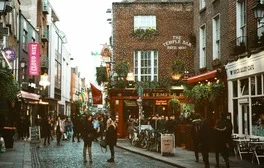
Temple Bar and Traditional Pubs: Temple Bar district (south bank of River Liffey) is Dublin's cultural quarter - cobblestone streets, traditional pubs, restaurants, galleries, street performers. Temple Bar Pub (namesake, 1840) is most photographed - red facade, hanging flower baskets, live music nightly, touristy but iconic. Other traditional pubs: The Brazen Head (1198, Ireland's oldest pub, Oliver Cromwell and revolutionaries drank here), O'Donoghue's (traditional music sessions), Kehoe's (Victorian decor, snugs), Toner's (original mahogany fittings). Pub culture is Dublin essence - not just drinking but socializing, music, storytelling, community. Traditional Irish music sessions (trad sessions) - fiddles, tin whistles, bodhráns, spontaneous, magical. Temple Bar transforming evenings - café terraces by day, packed bars at night, buskers, hen/stag parties (British especially), mix authentic and tourist Dublin. Beyond Temple Bar, neighborhoods: Smithfield (Jameson Distillery, hipster bars), Rathmines (student pubs), Ranelagh (village atmosphere).
Trinity College and Book of Kells: Trinity College (1592, Ireland's oldest university) is Dublin's academic heart - cobblestone squares, Georgian buildings, campanile, students in gowns, 47-acre campus central location. Long Room Library (1732) houses 200,000 oldest books - 65m oak-shelved barrel-vaulted hall, busts of philosophers/writers, stunning. Book of Kells (9th-century illuminated manuscript, Gospels in Latin, intricate Celtic designs) displayed in separate exhibit - Ireland's greatest cultural treasure. Visiting Trinity: Campus free to walk (respect students), Old Library/Book of Kells requires €16-18 ticket (book online avoiding queues). Allow 1.5 hours - exhibits, library, campus exploring. Trinity produced Beckett, Wilde, Burke - literary heritage significant. Graduates include Mary Robinson (former president), numerous writers. Campus oasis in city center - students sunbathing on cricket pitch, tourists photographing buildings, academic atmosphere.
Guinness Storehouse and Whiskey: Guinness Storehouse (St. James's Gate Brewery, 1.6km west of center) is Dublin's most-visited attraction - seven-story museum shaped like giant pint glass, brewing history, advertising, tasting, Gravity Bar (360° views over Dublin, complimentary pint included in €25 ticket). Guinness is Dublin identity - founded 1759, Arthur Guinness, black stout with creamy head, 'two-part pour' ritual, national drink. Storehouse touristy but comprehensive, entertaining, views excellent. Alternative: Jameson Distillery (Smithfield, Irish whiskey history, tasting, cocktail making). Irish whiskey differs from Scotch - triple distilled (smoother), no peat, spelled 'whiskey' not 'whisky.' Distilleries: Jameson (largest), Teeling (craft distillery), Pearse Lyons (St. James' Church converted). Dublin pub crawls combine Guinness/whiskey tasting with traditional pubs - popular activity.
Georgian Dublin and Doors: Georgian architecture (18th-19th century under British rule) defines central Dublin - terraced houses, sash windows, fanlights, colorful doors (red, blue, green, yellow - Instagram famous). Best Georgian streets: Merrion Square (Oscar Wilde statue in park), Fitzwilliam Square, Mountjoy Square. Doors became colorful allegedly when Queen Victoria died 1901 - Irish painted doors bright colors refusing to paint black in mourning (story disputed but charming). Georgian Dublin reflects 18th-century prosperity - Wide Streets Commission created boulevards, grand public buildings (Custom House, Four Courts by James Gandon). Many Georgian buildings now offices, hotels, embassies - Phoenix Park area has Áras an Uachtaráin (President's residence), US Ambassador's residence. Walking Georgian Dublin reveals architectural elegance - door photography popular tourist activity.
Phoenix Park and Kilmainham: Phoenix Park (707 hectares, one of world's largest urban parks) has wild fallow deer (400+), Dublin Zoo (1831, Europe's oldest), Áras an Uachtaráin (President's official residence, free tours Saturdays), Victorian gardens, cricket grounds, papal cross (Pope John Paul II mass 1979 attracted 1 million+), cycling/walking paths. Park is locals' weekend retreat - families, joggers, deer-spotting. Kilmainham Gaol (3km west, former prison) is powerful historical site - leaders of 1916 Easter Rising executed here, guided tours explain Irish independence struggle, Robert Emmet, Charles Stewart Parnell imprisoned. Visiting Gaol is emotional, essential for understanding Irish history - British occupation, rebellion, independence won 1922. Tours book out weeks ahead - advance reservation critical. Allow 90 minutes. Kilmainham combines with Guinness Storehouse, IMMA (Irish Museum Modern Art nearby in former military hospital).
Literary Dublin: Dublin is UNESCO City of Literature - four Nobel laureates (Yeats, Shaw, Beckett, Heaney), Joyce, Wilde, Swift, Stoker all Dubliners. Dublin Writers Museum (Parnell Square) documents heritage. James Joyce sites: Sweny's Pharmacy (Bloomsday June 16 pilgrimage retraces 'Ulysses' Leopold Bloom's journey), Davy Byrne's pub, Martello Tower (now Joyce Museum). Trinity College Long Room inspired Harry Potter library scenes allegedly. Literary Pub Crawl (evening tour combining pubs with actors performing literature) entertaining. Dublin celebrates writers - statues (Wilde on Merrion Square, Joyce on North Earl Street), plaques, museums, annual Bloomsday festival. Irish storytelling tradition persists - pub conversations, wit, wordplay, craic (fun, good times - pronounced 'crack'). Dublin's literary heritage draws book lovers globally.
Irish Food and Culture: Irish cuisine evolved from basic (potatoes, cabbage, stew) to sophisticated - Michelin stars, farm-to-table, artisan producers. Traditional: Irish stew (lamb, potatoes, carrots, onions), boxty (potato pancakes), colcannon (mashed potatoes with cabbage/kale), soda bread, full Irish breakfast (bacon, sausages, black/white pudding, eggs, beans, tomatoes, toast). Seafood excellent - oysters, mussels, Dublin Bay prawns. Modern Dublin restaurants: Chapter One (Michelin star), Forest Avenue, Bastible. Seafood: Klaw (oysters), Fish Shop. Brunch culture strong - weekend queues for avocado toast, eggs Benedict. Irish culture warm, welcoming - 'craic' essential concept (fun, conversation, atmosphere), storytelling tradition, music heritage (U2, Thin Lizzy, Dubliners from Dublin), GAA sports (Gaelic football, hurling - Croke Park stadium), rugby (Six Nations). St. Patrick's Day (March 17) is massive - parade, greening of Dublin, worldwide celebrations. Irish hospitality genuine - strangers become friends in pubs.
Practical Dublin: Dublin is expensive - accommodation, dining, pubs costly by European standards (pint €6-7, meals €15-25, hotels €100+). Euro currency. English language (Irish/Gaelic on signs, rarely spoken daily). Public transport: Dublin Bus (extensive network), Luas (tram, two lines - Red/Green), DART (coastal rail), all integrated with Leap Card. Airport connection: Airlink Express 747/757 to city center (€7-8, 30-40 minutes), private bus companies, taxis (€25-35). Walking central Dublin feasible - compact, Trinity to Temple Bar 10 minutes. Peak season: June-August (15-20°C, long daylight, festivals), St. Patrick's week (March). Winter mild (5-10°C) but wet - rain frequent year-round, pack umbrella/jacket always. Dublin transformed since 1990s - EU membership, Celtic Tiger boom (1995-2007), tech hub (Google, Facebook, Apple European HQ), younger population, cosmopolitan. Homelessness, housing crisis visible - tent encampments, rising costs displacing locals. Dublin requires 3-4 days - Trinity, Guinness, pubs, museums, parks, literary sites. Day trips: Howth (coastal village, cliff walk, 30 minutes DART), Glendalough (monastic site, Wicklow Mountains, 1.5 hours bus), Newgrange (5,000-year-old passage tomb older than pyramids, 1 hour north). Dublin is friendly, fun, literary, expensive - balance costs with experiences, embrace pub culture, appreciate resilience.
Frequently Asked Questions
· If a transfer is canceled less than 36 hours prior to a transfer time, we will keep the prepaid amount and a refund will not be processed
· The refund process will not be executed for cancellations received less than 36 hours before the scheduled transfer time. In these situations, we will email you a cancellation note that can be used in order to settle the costs from your tour operator, airline, or travel insurance company
· If a flight is delayed for more than an hour, we would need to check our availability first
· Please, keep in mind if we are unable to complete a transfer in which a flight is delayed for more than an hour, Jam Transfer is not responsible if a transfer was not completed and will act in accordance with our Terms and Conditions