Skopje Airport (Alexander the Great) Airport Transfer Options: Your Gateway to North Macedonia's Capital and Balkan Surprise
Skopje Airport serves North Macedonia's controversial capital and Balkan crossroads. This gateway welcomes visitors to fascinating Skopje with Skopje 2014 neo-classical makeover, Ottoman Old Bazaar (Čaršija), Stone Bridge over Vardar River, Mother Teresa Memorial House, fortress overlooking city, proximity to Lake Ohrid UNESCO site, Matka Canyon nature escape, and gateway to the Balkans' most polarizing architectural experiment. Located 17 kilometers east of Skopje city center, Alexander the Great Airport (name contested by Greece) provides access to unexpected North Macedonia.
Popular Transfer Routes from Skopje Airport (Alexander the Great) Airport
Choose from our most popular transfer destinations:
Private transfers provide the ultimate convenience and comfort for traveling from Skopje Airport (Alexander the Great) Airport to your destination. Your professional driver will meet you at arrivals with a personalized sign, assist with your luggage, and transport you directly to your hotel in a modern, comfortable vehicle.
- Direct door-to-door service to any Skopje destination
- No waiting or shared stops
- Professional Macedonian/English-speaking drivers
- Fixed, transparent pricing with no hidden fees
- Available 24/7 throughout the year
- Air-conditioned comfort
- Child seats and special requirements accommodated
- Drivers with excellent Skopje knowledge
- Luxury vehicles available (Premium and First Class)
- Ideal for families and business travelers
- Perfect for travelers with luggage
- Navigate to both old and new town
- Premium service at higher cost than public transport
- Advance booking recommended
- Night surcharges may apply (22:00-06:00)
JamTransfer specializes in premium Skopje Airport (Alexander the Great) airport transfers throughout Skopje and North Macedonia.
Vardar Express shuttle bus connects airport to city center.
- Direct to city center - 25-30 minutes
- Affordable (175 MKD / approximately €3)
- Coordinated with flight arrivals
- Comfortable air-conditioned buses
- Good luggage space
- Limited departures (not 24/7)
- May not run for late night flights
- Drops at central point, not hotels
- May require additional transport to accommodation
Public buses connect airport area to city.
- Very cheap (35 MKD / €0.60)
- Local experience
- Does NOT go directly to terminal
- Requires walk to bus stop
- Infrequent service
- Very challenging with luggage
- Not practical for tourists
Official taxis are available at designated airport ranks.
- No advance booking required
- Direct transport to any destination
- Available for immediate departure
- Affordable Macedonian prices
- Approximately 1,200-1,500 MKD (€20-25) to center
- NEGOTIATE price before departure
- Some drivers may try to overcharge
- Variable English proficiency
- 17km distance can vary with traffic
For guaranteed service with fixed pricing, book your Skopje airport transfer online in advance through JamTransfer.
Car rental is available at Skopje Airport (Alexander the Great) Airport with local companies.
- Essential for exploring Lake Ohrid
- Visit Matka Canyon independently
- Freedom for countryside trips
- Drive to Albania, Kosovo, Greece borders
- Cost-effective for groups
- Affordable rental rates
- Not needed for Skopje city only
- City is compact and walkable
- Traffic can be chaotic
- Parking difficult in Old Bazaar
- Road quality varies outside cities
Hotel shuttles are offered by some Skopje hotels.
- Available at some hotels
- Sometimes included in room rate
- Direct service to accommodation
- Must arrange in advance through hotel
- Limited to hotels offering service
- Limited departure times
- Often additional cost
- Not widely available
Why Choose JamTransfer for Your Skopje Airport (Alexander the Great) Airport Transfer?
At JamTransfer.com, we understand Macedonian hospitality:
- ✓ Personalized meet and greet at arrivals
- ✓ Professional drivers with Skopje knowledge
- ✓ Macedonian and English-speaking drivers
- ✓ Fixed transparent pricing in euros
- ✓ 24/7 customer support
- ✓ Free cancellation up to 36 hours before
- ✓ Child seats available
- ✓ Comfortable air-conditioned vehicles
- ✓ Premium and First Class luxury options
- ✓ Service to all Skopje areas and North Macedonia
- ✓ Local recommendations for Old Bazaar, Ohrid, Matka Canyon
Special Considerations for Skopje Airport (Alexander the Great) Airport Transfers
Skopje 2014 and Architectural Controversy: Skopje 2014, the government's €500+ million project, transformed the city center with over 130 neo-baroque and neo-classical buildings, monuments, and statues. The result is unlike anywhere else - a bizarre collision of ancient Macedonia, Austrian Empire aesthetics, and nationalist kitsch. Love it or hate it, nobody finds it boring.
Macedonia Square centers the spectacle with the massive Alexander the Great statue (officially 'Warrior on Horse' to avoid Greek protests over name). Surrounding it are the Archaeological Museum (resembling a palace), government buildings with columns and porticos, and dozens of bronze statues of historical figures. The Ministry of Foreign Affairs looks like it belongs in Vienna, not the Balkans.
Critics call it Disney Balkans - artificial, expensive, and historically dubious. The government spent millions while poverty remained high, triggering protests. The architecture mixes styles randomly with no coherent vision. Yet visitors often find it unexpectedly entertaining - where else can you see ancient warrior statues beside baroque buildings beside communist blocks, all built in the 2010s?
Old Bazaar and Ottoman Heritage: Čaršija (Old Bazaar) survived both the 1963 earthquake that destroyed 80% of Skopje and the Skopje 2014 makeover. This Ottoman quarter dates to the 12th century, making it the Balkans' largest bazaar outside Turkey. Narrow cobblestone lanes wind between workshops, mosques, and traditional restaurants.
Mustafa Pasha Mosque (1492) showcases classic Ottoman architecture with its rose garden courtyard. Daut Pasha Hammam (1473), once a Turkish bath, now houses art galleries. The Clock Tower and Kursumli An (caravanserai) complete the Ottoman architectural ensemble. Unlike the fake new town, these buildings are genuinely historic.
The bazaar remains commercial - goldsmiths hammer jewelry, copper workers craft traditional items, and restaurants serve Macedonian tavče gravče (beans) and Turkish börek. Unlike touristy Sarajevo's Baščaršija, Skopje's bazaar keeps working-class authenticity. Locals shop for meat, spices, and clothes while tourists photograph the centuries-old lanes.
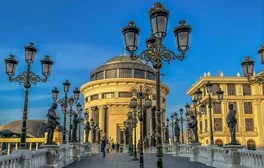
Stone Bridge and Vardar River: The Stone Bridge connects Macedonia Square with the Old Bazaar across Vardar River. Built in the 15th century on Roman foundations, it survived the 1963 earthquake while much of Skopje collapsed. The bridge symbolizes continuity through disaster, making it Skopje's emotional heart.
Skopje 2014 lined the bridge with statues - musicians, saints, revolutionaries - creating a sculptural gauntlet tourists must navigate. The effect is overwhelming rather than elegant, but undeniably photo-worthy. Night illuminations transform it into a golden gateway between old and new Skopje.
The Vardar River itself flows brown and often shallow, less impressive than Danube or Sava but central to city identity. Riverside parks offer walking paths, though the 2014 project's concrete embankments replaced natural riverbanks. Cafés line the waterfront where Macedonians practice their beloved café culture - sitting for hours over single coffee.
Kale Fortress and Earthquake Legacy: Kale Fortress occupies the hill overlooking the Old Bazaar. Byzantine foundations support Ottoman walls and towers. The views reward the short climb - Skopje spreads below with Mount Vodno rising behind. The fortress is more ruins than intact castle, giving it romantic rather than imposing character.
The 1963 earthquake killed over 1,000 people and left 200,000 homeless. Brutalist rebuilding followed, funded internationally. Japanese architect Kenzo Tange designed the master plan creating the modern city's layout. The train station clock stopped at 5:17am - the exact earthquake moment - remains as memorial.
This disaster explains Skopje's architectural schizophrenia. Ottoman buildings survived the quake. 1960s-70s brutalism rebuilt the center. Then Skopje 2014 overlaid neo-classical fantasy. Three completely different aesthetics compete for attention, creating the strangest capital cityscape in Europe.
Day Trips - Lake Ohrid and Matka Canyon: Lake Ohrid (170km southwest, 2-3 hours) is North Macedonia's crown jewel. This ancient lake, one of Europe's oldest and deepest, offers clear waters, Byzantine churches, and the town of Ohrid with its amphitheater and fortress. UNESCO-listed for natural and cultural heritage, it justifies its own 2-3 day visit rather than rushed daytrip.
Matka Canyon (15km west, 30 minutes) provides quick nature escape. The dam-created lake in steep-sided gorge allows kayaking, cave visits (Vrelo Cave), and hiking. Restaurants line the shore serving fresh trout. This works perfectly as half-day trip from Skopje when Old Bazaar and statue-watching become exhausting.
Mount Vodno (1,066m) rises directly behind Skopje, accessible by car or cable car (recently completed). The Millennium Cross on top (66m tall, visible citywide) marks Christian heritage. Hiking trails, restaurants, and views make it popular weekend escape for Skopljani (Skopje residents).
Macedonian Identity and Practicality: North Macedonia's identity remains contested. The name itself changed from 'Macedonia' to 'North Macedonia' in 2019 after decades of Greek objections over shared heritage with ancient Macedonia. Alexander the Great belongs to both/neither depending on perspective. This naming dispute affected everything from airport names to EU membership.
The language is South Slavic, related to Bulgarian and Serbian but distinct. Cyrillic alphabet is official, though Latin appears frequently. English is spoken by younger people, while older generations may know Serbian or some German. The Macedonian denar (MKD) is currency, roughly 61 MKD = €1.
Macedonian cuisine blends Balkan and Turkish influences. Tavče gravče (baked beans), ajvar (pepper spread), turli tava (vegetable and meat stew), and šopska salad dominate. Turkish coffee and strong rakija accompany meals. Prices are cheap - meals €5-8, beer €1.50-2, hotels €30-60.
Public transport includes buses (35 MKD / €0.60). Taxis are affordable but negotiate prices beforehand or use apps. Central Skopje is walkable between the baroque new town and Ottoman old bazaar. Weather: summers are hot (30-35°C), winters cold with snow (0 to -10°C). Two days covers Skopje's contrasts; longer stays allow Ohrid, Matka, and deeper exploration of the Balkans' most surprising capital.
Frequently Asked Questions
· If a transfer is canceled less than 36 hours prior to a transfer time, we will keep the prepaid amount and a refund will not be processed
· The refund process will not be executed for cancellations received less than 36 hours before the scheduled transfer time. In these situations, we will email you a cancellation note that can be used in order to settle the costs from your tour operator, airline, or travel insurance company
· If a flight is delayed for more than an hour, we would need to check our availability first
· Please, keep in mind if we are unable to complete a transfer in which a flight is delayed for more than an hour, Jam Transfer is not responsible if a transfer was not completed and will act in accordance with our Terms and Conditions